
Inside Claiborne County Property Tax Records
The Delta property and tax portal pulls assessment and payment data into a single view. That makes Claiborne County property tax records easier to compare line by line. Match the portal's exact label and year when you check figures against it.
| Field | What It Shows | Where |
|---|---|---|
| Total or true value | Appraisal value before the class ratio | Tax detail and GIS |
| Assessed value | Value after the statutory ratio | Tax detail and GIS |
| Homestead and exemption codes | Codes displayed for that record and year | Tax detail |
| County, city, and school tax | Due, paid, and balance lines | Tax detail |
| Tax district | District assignment used in the roll | Tax detail and GIS |
| Tax-sale history | PPIN-specific sale-search link | Tax detail |
Mississippi DOR gives the formula plainly. True value times the assessment ratio times the millage rate produces the tax. Neither true value nor assessed value equals the sale consideration recorded in a deed, so figuring that number out may mean opening the deed image itself.
The Claiborne Sample Separates Value From Tax
One Claiborne County tax roll entry shows how the numbers break down. For parcel 000004, the 2025 Claiborne County property tax record listed land at 570 and no improvement value, for a total value of 570 and an assessed value of 86. The county portion came to 6.91 and the school tax to 3.25, so the full bill reached 10.16, paid in full with a zero balance and a last payment date of January 6, 2026. The homestead code was None and the parcel sat in tax district 4000. The official tax detail displays all of these figures on one page.
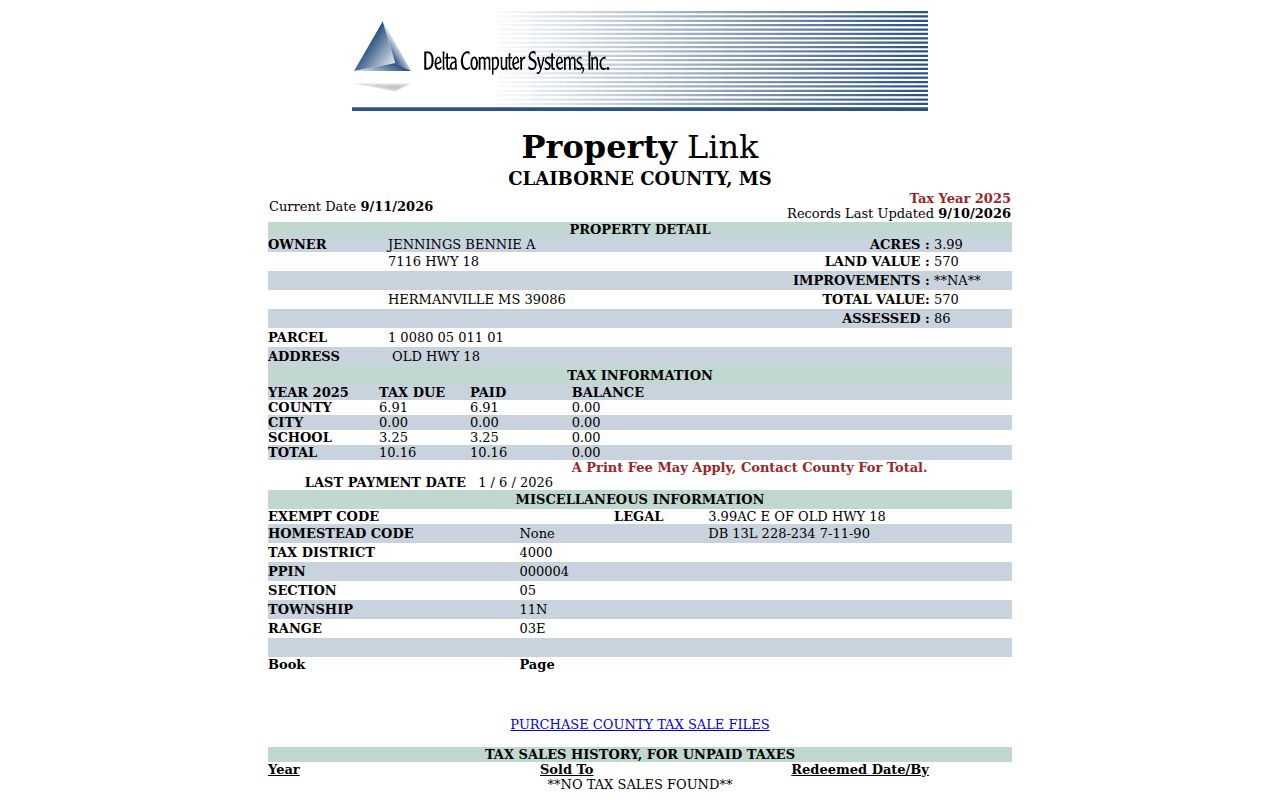
The same result lists OWNER, with a mailing-looking address, apart from the property ADDRESS. That layout is a useful reminder. A bill's mailing address is never a safe stand-in for where the parcel sits.
Search Fields for the Claiborne Tax Roll
| Field | Observed format | When to use it |
|---|---|---|
| Name | Last first, up to 35 characters | Find holdings under one roll name |
| Address | Number up to 6; street up to 30 | Known property site |
| Parcel Number | Up to 20 | Exact assessment record |
| Section/Township/Range | Separate land fields | Rural acreage |
| PPIN | Up to 6 | Reopen a known Delta record |
The search form marks no field as required and advises entering information into one field only. If a rural address misses, try the street alone. The PPIN, parcel number, or land-location fields work better than stacking on more uncertain text.
Mississippi Assessment Classes Change the Math
Assessment classes drive the math. The Mississippi Department of Revenue property-tax guidance assigns owner-occupied single-family homes to Class I. That class uses a 10 percent assessment ratio. Other real property generally falls under Class II at 15 percent. Personal property sits in Class III at the same 15 percent. Public utilities and motor vehicles use 30 percent classes. In the sample, the 86 assessed against a 570 total works out to roughly 15.1 percent after rounding and presentation. That fits a 15 percent relationship. One public row, though, cannot settle whether a parcel qualifies for a class.
Value terms. True or market value is the appraisal concept, assessed value applies the statutory class ratio, millage converts the assessed base to tax, and deed consideration is a different record.
Claiborne Real Property Revaluation
Mississippi law requires a revaluation of real property at least once every four years. Claiborne County posts no notice of its most recent countywide revaluation or the next scheduled cycle. The current dates need a call to the assessor. A portal's "Records Last Updated" line only describes a database refresh. It is not a revaluation date. Before preparing an objection, ask the assessor which appraisal date, property characteristics, and comparable evidence support the value now on the roll. Ask which comparable evidence supports the value now on the roll.
Homestead Dates Begin in January
The homestead calendar starts the year. State homestead guidance and the county calendar set the application season. It runs from early January through April 1. January 1 controls ownership and occupancy status. County guidance says applications open January 2. January 7 is the last day an instrument conveying title may be filed for eligibility. DOR generally requires ownership and primary-residence occupancy on January 1, with recording before January 7.
Regular, age/disability, and qualifying military or veteran rules each carry their own relief structure. Each has its own paperwork. A change in ownership, deed, occupancy, use, marital status, or death may force reapplication. A blank or None code in one public record never decides whether an applicant qualifies.
The Claiborne Tax Calendar Has Several Checkpoints
The county calendar spreads its checkpoints across the year. February 2 starts a one-percent penalty on certain property taxes. The first Monday in July opens presentation and public inspection of the assessment roll. The first Monday in August is the deadline to appeal an assessment. The last Monday in August brings the delinquent real-property land sale. October 1 begins new millage. Notices go out around the fourth Wednesday in November. Payment acceptance starts December 26.
State and county materials describe sale timing in different contexts. Before applying any generic date to a specific parcel, confirm the current year's published sale notice with the Tax Assessor/Collector and the Chancery Clerk.
Tax-Sale History Is Parcel-Specific
Tax-sale history is strictly parcel by parcel. The sample detail includes a "View tax sales history, for unpaid taxes" link. The portal lists no sales for that PPIN. That empty screen is not a countywide clearance. It does not rule out another parcel, lien, judgment, redemption, release, or court proceeding. For a distressed-property file, tie the tax-detail history to the deed index, the published notice, the Chancery filing, and any later instrument. A single tax deed or sale entry rarely answers whether redemption or confirmation came afterward.
Build the event trail in date order. Save the account status and tax year. Locate the county sale notice. Check the courthouse bulletin board or newspaper route. Search for a tax deed or release, and inspect every later conveyance. A notice describes one step in the process. It proves neither the present owner, the end of a redemption period, nor the result of a court action.
Blank and NA Fields Need a Narrow Reading
A sample roll entry may show improvements as NA. A blank exemption field and homestead code None may also appear. Read those blanks narrowly. They describe one Claiborne County record for one tax year. Nothing there proves the land never carried an improvement, exemption, or earlier assessment treatment. Keep the tax year and the portal update notice. Compare prior rolls where they exist. Ask the assessor directly whenever a blank field's meaning affects an appeal or a transaction. Property tax records are working documents rather than final proof.
Property tax records are not a survey or title report, either. The deed reference simply points to the recorded instrument. The GIS polygon and acreage serve as assessment aids. Ownership, boundary, and value questions each belong with the source created for that purpose.
Look Up a Claiborne County Tax Bill
Match the parcel number and tax year before trusting any result. A mailing address, an owner-of-record string, or a neighboring tract can easily masquerade as the Claiborne County tax bill you actually need.
- Search Delta by address, owner, parcel number, section-township-range, or PPIN.
- Confirm PPIN, parcel, legal description, acreage, and tax year.
- Read county, city, school, total due, paid, balance, and last-payment lines.
- Record exemption and homestead codes exactly as displayed.
- Open tax-sale history and contact the county about any delinquency or pending sale.
- Assessed value
- The value after the class ratio.
- Millage
- The rate applied to assessed value.
- Homestead exemption
- Relief requiring timely eligibility and application.
- Tax lien
- A statutory claim connected to unpaid tax.
Challenge a Claiborne County Assessment
Start with the current roll entry for the parcel. Then ask Tax Assessor/Collector Diane T. Davaul's office for the current appeal form and its instructions. Gather parcel identifiers, appraisal facts, photographs, and comparable sales evidence before the hearing. The Board of Supervisors reviews valuations and hears objections. Public inspection and equalization hearings begin in July under the county calendar.
Separate factual corrections from value disputes. Wrong acreage, a parcel split, an incorrect building count, a bad mailing address, an erroneous class, or an exemption code problem may call for deeds, surveys, permits, photos, or assessor records. A true-value claim may need evidence tied to the valuation date. Ask which proof the office accepts. Whether the appraisal or inspection record is public is a question the office can answer. How delivery must be documented is another.
The local calendar matters. Preserve the notice date, the tax year, the office's stated deadline, and proof of filing. A phone call changes nothing. It does not amend the roll or preserve an appeal. If the board acts, obtain the written result. Ask the office to explain the next authorized review route rather than relying on a prior-year summary.
Appeal window. County guidance places the assessment appeal deadline on the first Monday in August. Verify the current year's exact date and filing requirements before relying on the calendar.
Homestead questions live in a different file. Keep the deed date, occupancy facts, application date, identity documents, and any age, disability, or qualifying military proof that current state and county instructions require. A blank code is not an eligibility decision.
If a requested appraisal lookup returns a database-object error, preserve that error. Then ask the Claiborne County assessor for the public record by PPIN and tax year. A failed response proves nothing. Do not assume extra appraisal fields or a local fee from it. Keep every response with the appeal file.