
Claiborne County Deed Records by Instrument
The Claiborne County Chancery Clerk serves as the recorder for Claiborne County deed records, filing instruments such as deeds, mortgages, construction and condominium liens, federal tax liens, and lis pendens. Each instrument type signals what a transaction involves. Still, the full image tells the real story.
Instrument type alone is not enough. The complete document must be read to confirm the parties, reservations, legal description, signatures, and prior references before relying on any Claiborne County property records.
| Deed Type | What It Does | Common Use |
|---|---|---|
| Warranty deed | Conveys the stated interest with warranties | Ordinary purchase transfer |
| Quitclaim deed | Conveys whatever interest the grantor holds | Family or corrective transfer |
| Special warranty deed | Uses narrower stated warranties | Limited-warranty transaction |
| Administrator or trustee deed | Conveys under estate or trust authority | Probate or trustee transaction |
| Tax or sheriff's deed | Records a statutory-sale transfer | Tax or execution trail |
A deed only claims to transfer an interest. A deed of trust, lien, right of way, restrictive covenant, release, or lis pendens can affect the same land without being the ownership deed at all. That is why a careful deed search covers the whole instrument family around each transfer.
Search the Delta Grantor-Grantee Fields
The public Delta land-record index lets you query by party, book and page, filing dates, land location, subdivision, lot and block, instrument number, and instrument type.
| Index field | Format or option | Deed-search use |
|---|---|---|
| Grantor or Grantee | Last first; include either role | Find transfers out or acquisitions in |
| Book and Page | Separate fields | Open a known reference |
| Filing Date | From and to | Limit a name-heavy result |
| Section, Township, Range | Directions and quarter sections | Target rural land |
| Subdivision, Block, Lot | County dropdown plus fields | Find platted property |
| Instrument | Number or type code | Retrieve a known filing |
Each result shows party roles, instrument type, filed date, instrument number, book and page, subdivision, and land-location fields. Keep the portal's exact spelling, since local subdivision labels carry historic forms and variants.
A 1979 Claiborne Warranty Deed Example
One Claiborne County deed illustrates what a single record can hold. Instrument 44913 was a warranty deed dated March 3, 1979. It was filed with the Chancery Clerk on April 3 of that year. The deed was recorded at book 10B, page 0138. It carried several grantors and named Cordelia Jennings as grantee. The land sat in Section 5, Township 11 North, Range 3 East. It covered roughly 0.7 acre.
Anyone wanting the document itself can pull it up directly. The official deed detail serves the one-page image for fifty cents.
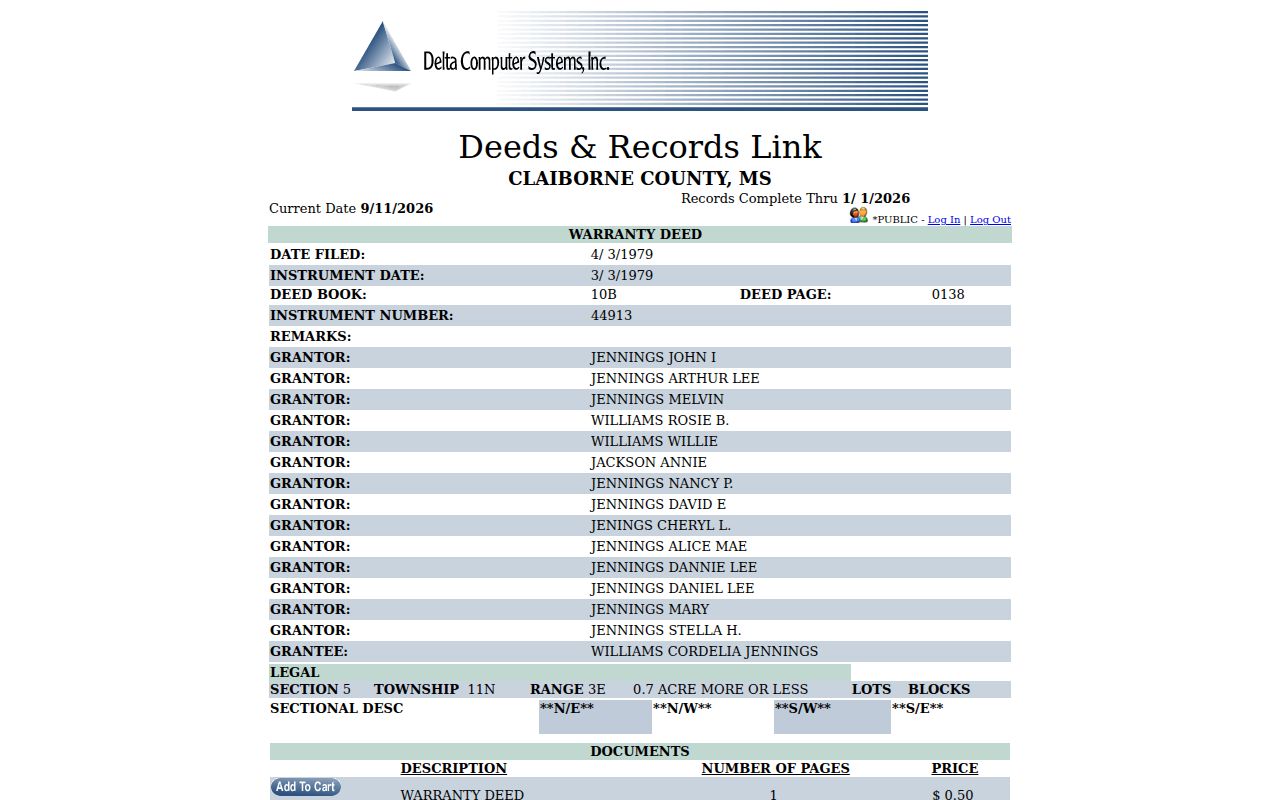
That entry shows why an index row is only a lead. The image itself carries the recorded wording you need to judge the transaction.
Claiborne Book-and-Page Images
The virtual index asks for DEED or MORTGAGE, book, and page, and it also allows browsing. Books carry internal names such as 0004I through 0019K rather than calendar years, and one sequence held 553 PDF pages.
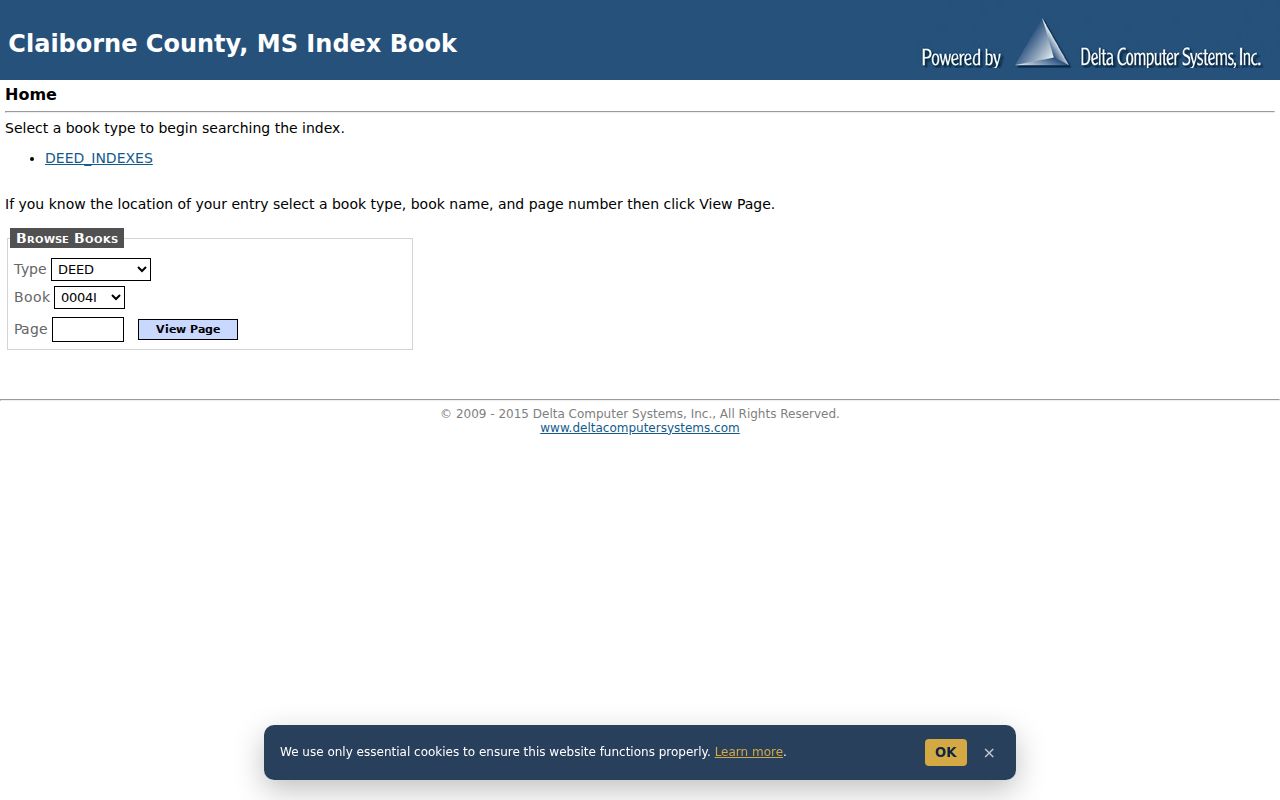
Log the book identifier, page, index hit, and image separately. Never infer a year from an internal book code. Note: Subscription prices advertised on the portal home are separate from the free index and per-image charge.
The Online Trail Reaches at Least to 1918
A broad query returns an online result dated March 18, 1918. That date is the earliest result seen, not an official cutoff. The MDAH Claiborne finding aid describes county holdings from 1848-1930 inside a broader 1799-1980 series. Mississippi State University Special Collections holds transcriptions of Deed Book A. It also holds Books B through D. Those volumes cover 1805-1815 ranges. A transcription can help you spot a reference. But check exact title language against the original or its image.
From Territorial Land to Current Parcels
Claiborne County was created in 1802, before Mississippi statehood. Early deeds often use adjoining owners, roads, rivers, bayous, plantation names, acreage, or section-township-range. Those older calls appear where a modern parcel number now appears. Match an older tract by comparing every surviving call. Do not force today's PPIN onto an instrument that predates it. Current GIS geometry helps you orient. But it cannot prove that historic and modern boundaries coincide.
Instrument Codes Broaden a Claiborne Deed Search
Delta's separate type lookup covers administrator deeds, affidavits of heirship, assumptions, timber deeds, reconveyances, releases, rights of way, restrictive covenants, sheriff's deeds, trustee's deeds, transfer-on-death deeds, tax deeds, and wills. It also covers warranty deeds. So a chain can continue through a filing. Its label may look nothing like an ordinary sale. Check the portal's current code list. Then read the document itself, since a three-letter code is not a legal conclusion. Release records deserve extra care. A release may satisfy the obligation it names. That alone does not prove every lien on the parcel has ended. A lis pendens likewise signals litigation, not who prevailed. Search later instruments and, when needed, the related Chancery or Circuit case.
When Probate or Court Orders Interrupt the Chain
Claiborne Chancery Court handles estates, property disputes, confirmation of title, and other equity matters. After an owner dies, the next entry may be an administrator deed, affidavit of heirship, will, distribution, or court order rather than a plain seller-to-buyer deed. Search every name variant: decedent, estate, executor, administrator, trustee, and heir. For non-restricted electronic Chancery cases, PAMEC can supply a docket and documents, with a $10 annual non-attorney account and $0.20 returned pages. Restricted or sealed material stays closed to that account. Match the court order's legal description and final disposition to the recorded instrument. A docket entry, complaint, foreclosure notice, or lis pendens proves a matter existed. It does not prove the final title result.
Walk the Claiborne Grantor-Grantee Chain
Start from the newest reliable deed reference. At every step, keep the filed date, instrument number, book and page, parties, and an exact legal-description match.
- Find the present owner's acquisition with that owner as grantee.
- Match its land description to the parcel.
- Search its grantor as a grantee in an earlier acquisition.
- Repeat while noting estate, corrective, tax, and release instruments.
- Carry the last book/page and parties to the clerk or archives when web coverage ends.
- Grantor
- The party transferring the stated interest.
- Grantee
- The party receiving the stated interest.
- Chain of title
- The linked sequence affecting the same land.
- Book/page and instrument number
- Separate retrieval references.
Request a Claiborne County Deed Copy
Start with Chancery Clerk Gloria Dotson. Call 601-437-4992, fax 601-437-3137, email gloriadotson@ccmsgov.us, or write P.O. Box 449, Port Gibson, MS 39150. The county publishes 410 Market Street. A court page shows 401 Market Street, so confirm the counter before traveling. Ask for the current plain or certified-copy fee. Include names, instrument number, book and page, filing date, and land description. Older records may sit at the counter, on microfilm, or at MDAH. The Mississippi Public Records Act supports a specific written request, a fee estimate, and a written explanation of any denial or exemption.
Recorded, not guaranteed. The index reports filed instruments, not complete or clear title. Indexing errors, unrecorded interests, later filings, and gaps require further verification.
Compare the Claiborne Index and Image
An index entry is only a summary. It can shorten party names, drop a spouse, fix a misspelling, or squeeze the legal description into a few fields. The recorded image tells more. A correction, reservation, easement, mineral interest, life estate, or prior deed reference may appear only there, never in the result list. For every key step in the chain, keep the index row and check it against the deed image by instrument number and book-page. No image online? Ask the Chancery Clerk for the recorded instrument and note the step as index-only until it arrives. A certified copy proves the custodian's copy of that filing. It does not certify a clear title chain.
Mortgages and deeds of trust form a parallel chain. Trace the original security instrument, later assignments, any substitute trustee, and the release or reconveyance tied to the same reference. Timber, oil, right-of-way, and restrictive-covenant filings can affect interests beyond an ordinary surface transfer. Log each branch. Record its dates, parties, legal description, and closing instrument. A common surname demands more than a name match. Compare acreage, road, section-township-range, subdivision, spouse or co-party, entity name, and prior deed citation before settling on a hit. Keep several candidates open until one legal description connects to the parcel. A long grantor list with a single grantee can make the list view hard to judge without the detail and image.
Online records reach back to 1918. Save the last reliable instrument before you switch repositories. Give an archive or clerk the book-page, exact parties, date span, tract description, and modern parcel clues. MDAH county series, early deed-book transcriptions at Mississippi State University, and archive microfilm can bridge the older chain. Label each as index, transcription, image, or original. Historic maps and newspapers may explain names and events. They never replace the recorded land instrument. Preserve the repository citation so the same source can be found again.